
Flavors of the North End: Beverages
Four stories of what the North End drank: cider the first national beverage, the colonial trade in Madeira, the Italian love of wine, and the homemade wine of North End cellars.
Jump to a story: Cider · Colonial Wine Traditions · Italian Wine Traditions · Making Wine
Cider: The First National Beverage
Apple cider has a strong case for being the original “American” beverage. It was the most popular drink in the New England colonies and drank daily into the early 19th century. Cider was considered a safer and more healthy alternative to the wells of Boston, regardless of the actual water quality.
The term “hard cider” is a modern convention since originally all cider was fermented. The strongest cider would be reserved for adult men and a weaker variant was consumed by women. Young children and the sick would drink a much weaker, diluted cider called ciderkin. The fresh cider available at apple orchards today was not considered cider at all, same as in Europe.
English colonists brought their love of cider to Massachusetts Bay by introducing domesticated apple trees, which are not native to North America. Early settlers brought seeds, along with grafts of apple trees. They jumpstarted their orchards by grafting onto wild, native crabapple trees.. Many of these early orchards were dedicated to cider apples, but sweet apples were also grown.
William Blackstone (Blaxton) the first European settler of Boston, is credited with the first American apple cultivar, sometime in the late 1620s. It was a versatile “sweet” apple called the yellow sweeting, that was good for home use and cider. It has since gone extinct but the Roxbury russet, is a surviving heirloom variety that dates to about the same time.
The growth of rum distilleries thanks to the Triangle Trade, began to cut into cider’s market share. However it was the arrival of German immigrants in the 1840s that truly started cider’s decline with the rise of beer. Prohibition in the 1920s saw the end of many cider orchards as they transitioned to sweet apples and unfermented cider. Although hard cider has reemerged as a niche in craft brewing, it has never regained its near-universal popularity.
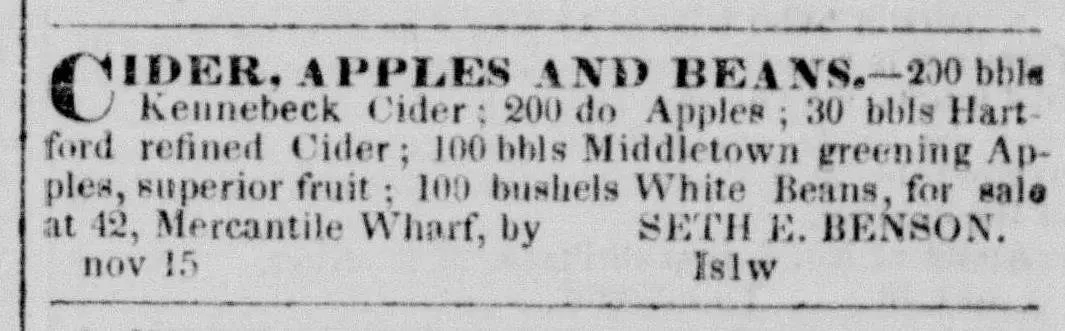
Medicinal Properties of Cider
Long before Germ Theory, apple cider was practically medicine. The purity of apples and a “healthful” amount of alcohol made cider both a folk remedy, and a prescribed medicine by early American doctors.
THIS excellent liquor contains a small proportion of spirit, but so diluted and blunted, by being combined with a large quantity of saccharine matter and water, as to be perfectly wholesome. When of a proper age, and well refined, pure cider may be considered as a pleasant and salutary beverage, and calculated to obviate a putrid tendency in the humours.
- The American Orchardist (1825)
Colonial and Early American Wine Traditions
CHOICE WINES. Just arrived and to be sold by Arichibald Cunningham at his shop on Fore Street, near the Draw Bridge. Lisbon, Malaga, Claret, and Madeira wine sold by the cask…- The Boston-Gazette, and Country Journal, 5 April 1773
Practically everyone drank cider and ale in Colonial Boston, but the upper classes brought their taste for imported wines as well. The New England coast was not conducive to European style vineyards and the local “fox” grape varieties (like concord grapes) were considered too musky to make good wine.
French wines like claret from Bordeaux were highly desirable, but long voyages in a humid ship’s hold would often ruin the wine. The numerous conflicts between England and France would also shut off the supply completely at times. Spanish and Portuguese wines were also imported to Boston, but had the same risk of spoilage. However, there was another type of wine that would survive the voyage and later helped fuel Boston’s revolutionary spirit.
Madeira
Madeira is a fortified Portuguese wine that was ideal for long sea voyages. Similar to port wine, it would not spoil because of its higher alcohol content. The distinctive “burnt” taste of Madeira is due to oxidation and became very popular in Colonial America. It became so popular in Britain and the Colonies, that British exporters held a monopoly on this Portuguese wine. Not far behind, American merchants and smugglers unloaded and sold their casks of Madeira on the Boston waterfront.
The Sons of Liberty plotted over glasses of Madeira, brought to Boston by their fellow Patriot smugglers. Customs officers were often bribed, or the cargo unloaded late at night to avoid paying duties. The most famous and wealthy of these Boston importer-smugglers of Madeira, was none other than John Hancock.
This Founding Father’s North End property included Hancock’s Wharf, which he inherited from his family, and is today the site of Lewis Wharf. It was here in June 1768 that Hancock’s sloop, the Liberty, was seized in Boston Harbor in 1768 over a previous shipment of supposedly smuggled Madeira. Bostonians crowded the wharf in protest, in an event known as the Liberty Riot, which sent customs officials running for their lives.
Fortified wines were falling out of popularity by the 1840s once improved shipping, and the use of ice made importing wine less risky. In the 1850s immigrants were creating the American wine industry, while the vineyards of Madeira were wiped out by disease. Madeira’s vineyards eventually recovered, but never regained its former popularity.
In Vino Veritas: Italian Wine Traditions
Italians have a love of wine that is counted in millennia rather than years. The unofficial food rules that immigrants brought to the North End, regardless of what region of Italy, practically required wine at the table. The North End swelled with both Italian immigrants and large Italian-American families by the turn of the 20th century. This created a demand for what was a staggering amount of wine for both home use and the growing list of Italian restaurants.
Entrepreneurs in the neighborhood were quick to create importing businesses, some specializing in wines. North End wine shops were fully stocked with imported, domestic and locally made wine, to serve all income levels. Even the poorest day laborer could look forward to a crusty loaf and some cheap red wine after a hard day building Boston.
Wines from Italy and California
The wine importer of Boston’s Italy is an everyday sort of man, who toils from early morn to late at night. He has his cellars stocked with the best, and in many cases conducts a general trade in goods imported from Italy.- Boston Globe: May 27, 1894
In 1894 a local reporter estimated that 25,000 gallons of Italian wine was imported to the North End annually. This accounted for about half of the neighborhood’s total wine consumption of 50,000 gallons. There was wine available for every social level, and for those that could afford it, plenty of imported Italian favorites. One North End wine merchant had over 25 imported wines that included Barolo, Chianti, Faro de Messina, Nebbiolo, Tarragona and also Italian grappa.
A portion of the other 25,000 gallons of wine was supplied domestically by vineyards in California. North End merchants were early adopters of California grown wines. Italian-owned shops and restaurants advertised both Italian and Californian wines by the 1890s. By 1909 there were over two dozen wine retailers in the North End, selling foreign and domestic wines.
North End business also played a large role in spreading the popularity of California wines. Pastene & Co. is better known for their imported pasta and canned tomatoes, but once distributed wine as well. Pastene was the first to distribute California wines nationwide in the days before Prohibition. Pastene was also the sole distributor of Robert Mondavi wines in New England until the 1970s.
Another North End success story is the Martignetti Companies going back to 1908 and their original storefront on Salem Street. In 1933 this family grocery received the Commonwealth’s first alcohol retail license after Prohibition and began selling wines and liquors. Martignetti’s would expand out from the North End and by the 1970s was a major distributor of fine wines. Three generations later, the Company has grown to become the leading distributor of wines, spirits and beer in New England and the sixth largest wine and spirits distributor in the country.
Making Wine in the North End
Nineteen-twenty was the first year I make the first bottle of wine. I make a only one barrel, I have no money-could I make anymore? But now I make a three or four barrels for my family, my [grandchildren] like the wine, my daughter, and my son too. I’m eighty-three and haven’t stopped since.- Pasquale Capone: Stories, Streets and Saints by Anthony Riccio
The old cellars of the North End were once filled with wooden barrels giving off the pungent aroma of fermenting grape must. Boston’s climate did not deter Italian immigrants from continuing their time-honored winemaking traditions. Making wine at home took effort and patience, but rewarded the family with months of inexpensive wine and priceless memories.
There were some Italian farmers that recreated the vineyards back home in the Massachusetts and New York countryside, selling their grapes to local Italian communities, but most North End wine used California grapes. Wine grapes like zinfandel and moscato were imported to the docks in Chelsea from California every September. Some wine makers blended wine grapes with concord grapes from upstate New York. Concord and other table grapes are not known for making great wine, but North Enders learned to blend them with wine grapes, giving their finished products a deep red color.
These traditions were passed on through the family, and to neighbors and friends, who created their own winemaking traditions. Unfortunately modern life often gets in the way of traditions, and many families only have fading memories today. Home winemaking is not as prevalent as before, but some Italian-American families still make their own wine. In recent years, younger generations have shown an interest in these traditions and have begun to reintroduce them to their families.